
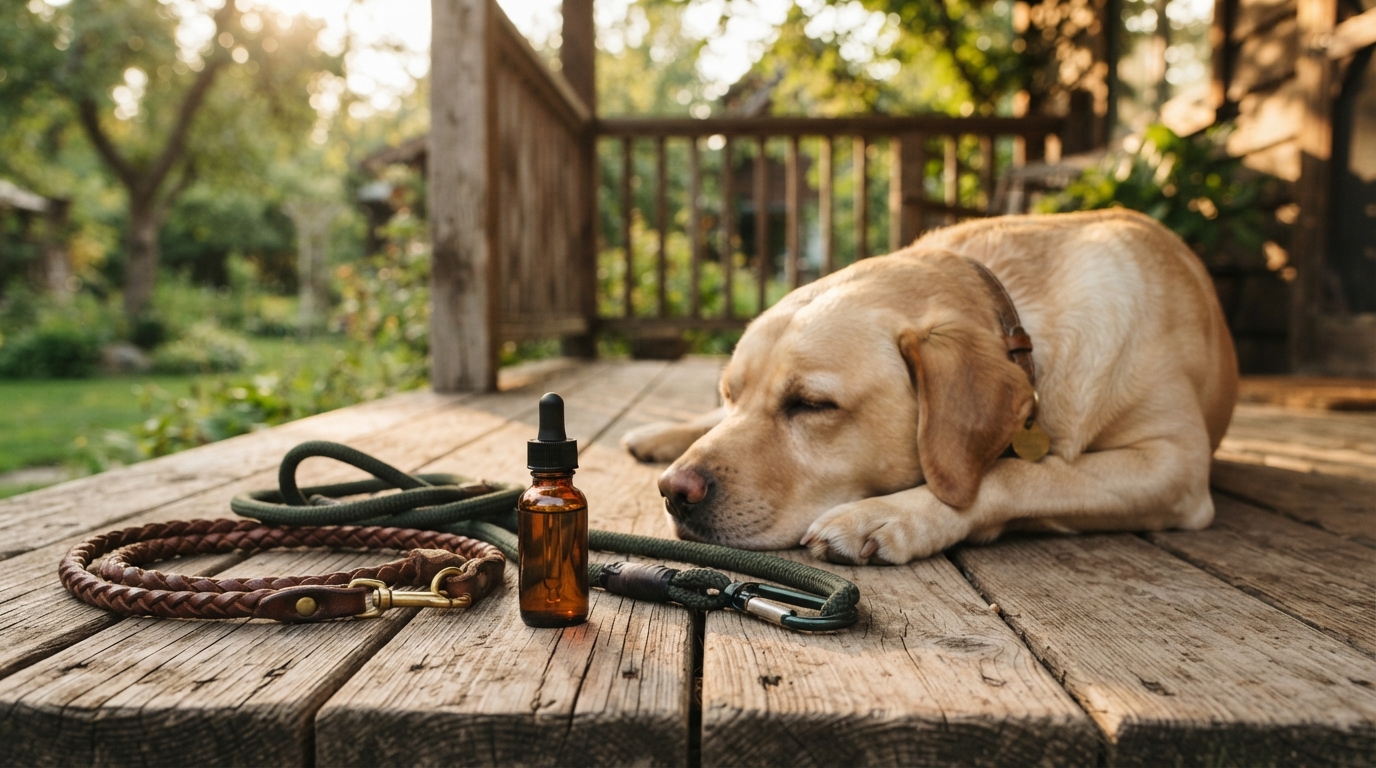
A lot of confident-sounding claims circulate about Holistapet CBD oil for dogs, and not all of them hold up against what’s actually documented. Separating the two matters, especially for owners making a decision about a dog’s ongoing care.
The Psychoactive Confusion
CBD oil will not get a dog high, full stop. That confusion traces back to CBD sharing a plant family with marijuana, but the compound itself doesn’t produce intoxicating effects. THC is responsible for that, and federally compliant hemp-derived oil is capped at 0.3% THC by dry weight, an amount far too small to cause any noticeable psychoactive effect. If a dog shows genuine impairment, stumbling, extreme lethargy, disorientation, after consuming something, it’s far more likely that dog got into a product with substantially higher THC content, not a properly labeled hemp oil.
“Hemp Oil” and “CBD Oil” Are Not Interchangeable Terms
This mix-up shows up constantly on store shelves. Hemp seed oil, sometimes just labeled “hemp oil,” is pressed from hemp seeds and contains little to no CBD at all, since cannabinoids concentrate mainly in the plant’s flowers and leaves, not the seeds. It’s a legitimate product in its own right, valued for omega fatty acid content and used in some pet foods as a nutritional additive, but it isn’t a substitute for CBD oil if the goal is an actual cannabinoid effect. Checking that a bottle specifically lists a CBD milligram content, rather than just “hemp oil” on the front label, is the fastest way to avoid buying the wrong product entirely.
“Natural” Doesn’t Automatically Mean “Risk-Free”
This one trips up a lot of well-intentioned owners. Because CBD oil comes from a plant, it sometimes gets treated as inherently gentler than pharmaceutical options, but the Cornell research mentioned in the studies overview found elevated liver enzymes in some dogs on higher CBD doses. Any compound processed through the liver, plant-derived or otherwise, carries some level of dose-dependent risk. That’s not an argument against using it, it’s an argument for using an actual measured dose rather than assuming more must be safer simply because it’s herbal.
Marijuana-Derived vs. Hemp-Derived Matters More Than Most Labels Make Clear
Not every “CBD oil” on the market comes from hemp. Products derived from marijuana plants remain federally illegal regardless of their CBD content, since marijuana itself stays classified as a Schedule I substance federally even where state law allows recreational or medical use for humans. These products aren’t formulated with canine physiology in mind and shouldn’t be assumed safe just because they’re technically CBD. Checking that a product explicitly states hemp-derived sourcing is a basic but often skipped step.
Comparing Common Claims to What’s Actually Documented
| Claim Often Seen in Marketing | What Current Evidence Actually Supports |
|---|---|
| “Clinically proven to eliminate arthritis pain” | Small clinical trials show reduced pain scores, not elimination |
| “100% safe at any dose” | Higher doses linked to liver enzyme changes in some dogs |
| “FDA-approved formula” | No CBD product currently holds FDA approval for animal use |
| “Cures anxiety” | Limited, mostly observational evidence for anxiety-related use |
| “Works instantly” | Onset varies; digestive absorption is generally not immediate |
Myth: If a Dog Tolerates It Once, Any Dose Is Fine Going Forward
Tolerance and dosing needs can shift over time, particularly for dogs with progressive conditions or those gaining or losing significant weight. A dose that produced no side effects during an initial trial period isn’t guaranteed to remain the right dose indefinitely, especially for senior dogs whose liver and kidney function can change gradually in ways that aren’t always obvious day to day without bloodwork. Periodic reassessment, rather than a “set it and forget it” approach, fits the current evidence better than treating an initial safe dose as permanent.
Myth: A Product Labeled “Vet Recommended” Has Been Formally Endorsed
Marketing phrases like “vet recommended” or “vet formulated” appear on a lot of packaging without a clear standard behind what they mean. Sometimes it reflects a genuine relationship with a consulting veterinarian involved in formulation; other times it’s closer to a marketing phrase with a single supportive quote behind it. Neither the FDA nor the AVMA maintains a formal certification program verifying these specific label claims, so the phrase alone isn’t a reliable substitute for checking the actual COA and ingredient list directly. A specific veterinarian’s name, credentials, and a way to verify their involvement carries more weight than the generic phrase by itself.
Why Vet Involvement Changes the Picture
A veterinarian looking at a dog’s actual medication list can flag interaction risk that no product label anticipates. CBD is metabolized through the liver’s cytochrome P450 pathway, the same system responsible for processing a wide range of prescription drugs, including certain anti-seizure medications and pain relievers. That overlap means a dog on existing medication benefits more from a vet consultation than from any amount of online research alone.
There’s also the diagnostic piece. Lethargy or appetite loss that gets treated as a CBD-fixable symptom might actually be a sign of something like kidney disease or hypothyroidism, conditions bloodwork would catch and a dropper bottle wouldn’t touch. CBD oil isn’t a diagnostic tool, and treating it like one risks delaying an actual answer.
It’s also worth knowing that not every veterinarian will bring up CBD unprompted, sometimes due to the state-level legal caution discussed elsewhere regarding what vets can formally recommend. Asking directly, rather than waiting for the topic to come up, usually gets a more useful conversation started.
Myth: A Bigger Brand Name Automatically Means Better Testing
Brand recognition and manufacturing quality don’t always move together in this industry, partly because CBD marketing spends heavily on packaging and influencer promotion, areas that have nothing to do with what’s actually inside the bottle. Independent testing initiatives run by various consumer groups and university researchers over the past several years have periodically found mislabeled CBD content, either higher or lower than stated, across products spanning both small and larger brands, which is a reminder that checking the actual COA matters more than checking follower counts or shelf placement.
A Quick Look at Market Growth
The pet CBD category has expanded substantially since the 2018 Farm Bill passed, according to tracking from cannabis market research firms like the Brightfield Group, and the American Pet Products Association’s National Pet Owners Survey has documented rising consumer awareness and interest in hemp-based pet products across several recent survey cycles. That growth has brought more competition into the space, which is generally good for buyers in terms of price and product variety, but it’s also brought in a wider range of manufacturing quality, since the barrier to entering this market (registering a brand and sourcing bulk extract from a third-party manufacturer) is lower than it might appear from a polished website.
Myth: CBD Oil Shows Up on Standard Drug Tests the Same Way THC Does
This one matters more for households than for the dog directly, but it comes up often enough to address. Standard drug screening panels are built to detect THC and its metabolites, not CBD itself. A compliant hemp-derived CBD oil, containing 0.3% THC or less, is generally not expected to trigger a positive result on a standard panel, though full-spectrum products carrying trace THC introduce at least theoretical risk of a false positive on more sensitive tests given repeated, high-dose exposure over time. This is a human drug-testing consideration rather than a dog-specific one, but it occasionally factors into a household’s decision between full-spectrum, broad-spectrum, or isolate products.
A Realistic Way to Evaluate Any Product Claim
Before trusting a specific claim, checking whether it names a real, checkable source (a university study, a named journal, a specific COA) versus a vague appeal to “recent studies show” without any citation is a reasonable filter. Vague sourcing is usually a sign the claim wasn’t built on much in the first place. A product page that says “studies show” without naming which study, which university, or which journal is functionally saying nothing verifiable at all.
Where Skepticism Is Actually Useful
Healthy skepticism doesn’t mean dismissing CBD oil outright. It means treating a bottle purchase the way any other supplement decision deserves to be treated: checking the actual documentation, understanding what’s been studied versus what’s assumed, and recognizing that a product working well for one dog doesn’t guarantee identical results for another. That’s a fairly ordinary standard to apply, and it happens to be one a surprising number of CBD product pages actively make harder to meet by leaving out the specifics that would let a buyer check for themselves.
Final Thoughts
Most of the misinformation around CBD oil for dogs comes down to a few recurring mix-ups, confusing CBD with THC, confusing hemp seed oil with CBD oil, and assuming “natural” means “no dosing risk,” and a quick veterinary conversation combined with a genuine lab report clears up all three far more reliably than marketing language alone.